Industry Insights
Balcony Solar Is Heading to UK Retail. Compliance, Not Price, Will Decide Whether It Works
June 18, 2026
Share:
Share:
When Amazon, B&Q, Currys, Screwfix, and Wickes show up at a UK government roundtable on plug-in solar, the subject is no longer confined to a small corner of the energy market.
The UK is exploring something that would have sounded unusual only a few years ago: allowing consumers to buy a small solar system through a mainstream retailer, mount it on a balcony, garden wall, or other suitable outdoor space, and connect it to a household circuit through a designated plug.
For renters, flat residents, and people without control of a suitable roof, the appeal is obvious. Traditional rooftop solar has often been out of reach because of property rights, installation costs, structural constraints, or the need for professional electrical work.
Plug-in solar could lower that barrier.
But one point is already being lost in some of the early coverage: the UK has not given consumers a blanket green light to buy any balcony solar kit and plug it into any wall socket.
The government is developing a regulatory pathway. The consultation is still open, the technical specification may still change, and batteries are explicitly outside the current scope.
So this is not really a story about a £400 solar kit.
It is a test of whether the UK can turn a product that currently sits in a regulatory grey area into a safe, standardised consumer energy appliance.
Conventional residential solar is usually sold as a property improvement.
It involves a site survey, system design, rooftop installation, electrical work, grid-connection procedures, and a relatively large upfront investment. The customer is not simply buying a few panels. They are buying an entire installation project.
Plug-in solar follows a different model.
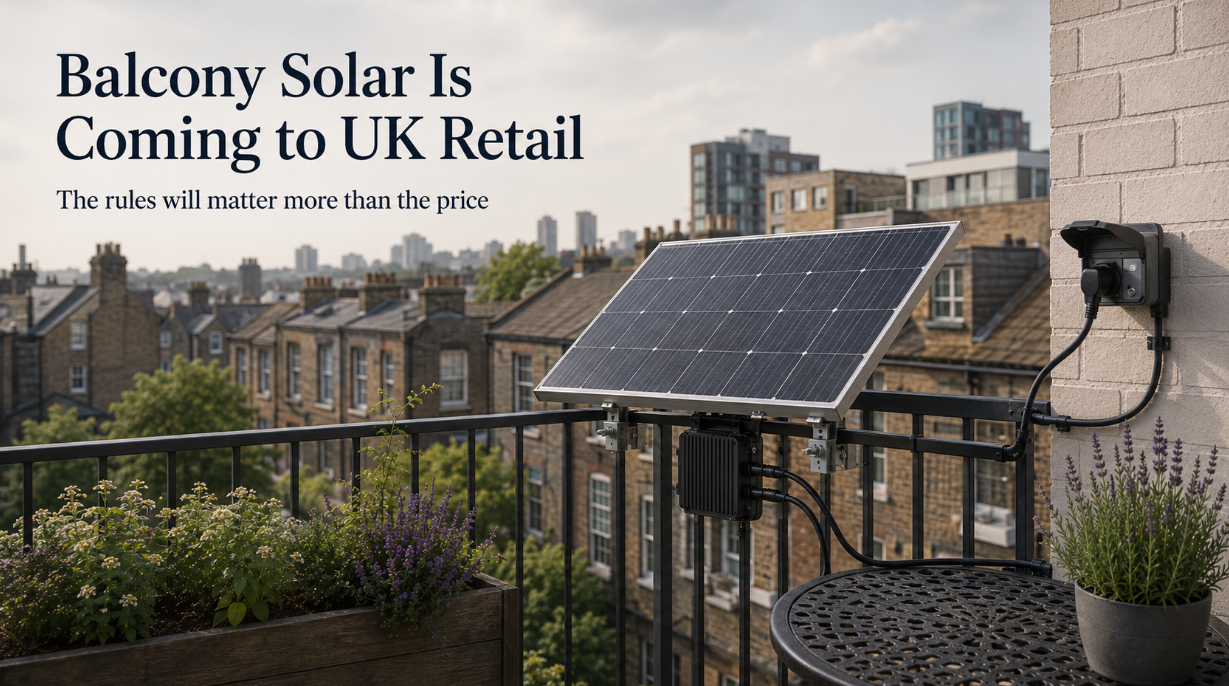
A typical system would include solar modules, a microinverter, mounting hardware, and a manufacturer-supplied cable with a UK plug. The panels generate direct-current electricity, the microinverter converts it into alternating current, and the power enters the household circuit to serve loads such as refrigerators, routers, computers, and other appliances already running in the home.
Neither solar panels nor microinverters are new.
What is new is the way the system is being packaged.
Instead of commissioning a solar project, a customer may eventually be able to buy a complete, standardised kit from a home-improvement store, electronics retailer, supermarket, or online marketplace.
That would bring residential solar within reach of people the traditional rooftop market has rarely served well.
But the closer these systems come to looking like ordinary appliances, the more important it becomes to remember that they are not ordinary appliances. They do not simply draw power from a socket. They feed electricity back into the household wiring.
The involvement of major retailers gives plug-in solar a route into the mass market.
It also gives those retailers responsibilities that go well beyond stocking another consumer electronics product.
The safety and reliability of a system will depend on far more than the rated output of the solar panels. Buyers will need confidence that:
This is one reason the UK cannot simply copy the German balcony-solar market.
A system that is legal and widely used in Germany does not automatically become suitable for the UK when someone changes the plug. Household wiring practices, plug standards, grid protections, and regulatory responsibilities are different.
The strongest products in this market will not necessarily be the cheapest or the ones with the highest advertised wattage.
Clear instructions, defined operating limits, reliable protection systems, safe mounting hardware, and traceable after-sales support will all be part of the product.
The UK government is proposing changes to existing plug, socket, and electrical safety rules so that compliant plug-in solar systems can be legally supplied and used.
The consultation is scheduled to close on June 30, 2026. Until the final rules are published, claims that a product is already “UK-ready” should be treated with caution.
Under the current draft, the maximum apparent power output would be 800VA, with a maximum current of 3.5A.
That limit is often misunderstood.
The 800VA figure applies to the microinverter’s AC output into the household circuit. It does not necessarily mean that the solar modules themselves are limited to a combined capacity of 800W.
The draft allows up to 2,000W of rated solar-module capacity. Oversizing the array could help the system produce closer to its inverter limit during cloudy weather, weak sunlight, or less-than-ideal installation conditions.
More panel capacity, however, does not automatically mean more useful electricity.
If a household is consuming only 200W when the system is generating 800W, the value of the remaining output depends on future metering, export, and grid-connection arrangements.
The current proposal is mainly focused on safe connection and self-consumption, not on turning balcony solar into a guaranteed source of export income.
One of the main attractions of plug-in solar is that it could avoid much of the complexity associated with a conventional rooftop installation.
But self-installation is not the same as installing a system without making any technical judgement.
Under the direction of the draft specification, a complete product would include the solar modules, microinverter, cable, non-rewireable fused UK plug, mounting system, and required safety protections supplied by the manufacturer.
Consumers would not be expected to assemble a grid-connected system from unrelated panels, inverters, cables, adapters, and connectors.
Extension leads, travel adapters, and multi-socket power strips should not form part of the connection method.
Before installation, a user may still need to consider:
The draft also suggests that professional assessment of the household wiring should be considered when total solar-module capacity exceeds 960W.
That alone makes the limit of the “plug-and-play” label clear.
Plug-in solar may be simpler than a rooftop installation. It does not remove the need for electrical and structural safety.
The UK government’s analysis uses an estimated system cost of roughly £400 to £600.
In one modelled scenario, panels facing south at a 30-degree angle could save a household around £110 per year. In another, using vertically mounted east-west panels, the estimated saving falls to around £70.
Those figures are useful as examples, not promises.
Actual savings will depend largely on four factors:
A home with a refrigerator, router, ventilation equipment, home-office setup, or other steady daytime loads may consume a meaningful share of the solar output as it is produced.
A property that is mostly empty during the day may use much less.
That is why adding more panels does not always lead to a proportional reduction in electricity bills. Once generation exceeds the home’s immediate demand, the value of the surplus depends on how that electricity is managed.
For many households, the best-performing system may not be the one with the highest theoretical output. It may be the one whose generation profile most closely matches the way the home actually uses electricity.
Batteries are not included in the present consultation.
That is not a minor technical omission. It defines the limits of the proposed market.
Without a battery, solar electricity must be used largely at the time it is generated. The system cannot automatically store surplus midday production for evening use, when household demand may be higher.
That does not make plug-in solar ineffective. Most homes have a constant base load from refrigeration, networking equipment, standby devices, and other appliances.
But it does mean that the current proposal is closer to a small grid-connected generation product than a complete home energy-management system.
A fuller system might combine solar generation, battery storage, time-of-use scheduling, automated load control, and managed interaction with the grid.
The UK is not there yet.
This distinction is also important for portable power products.
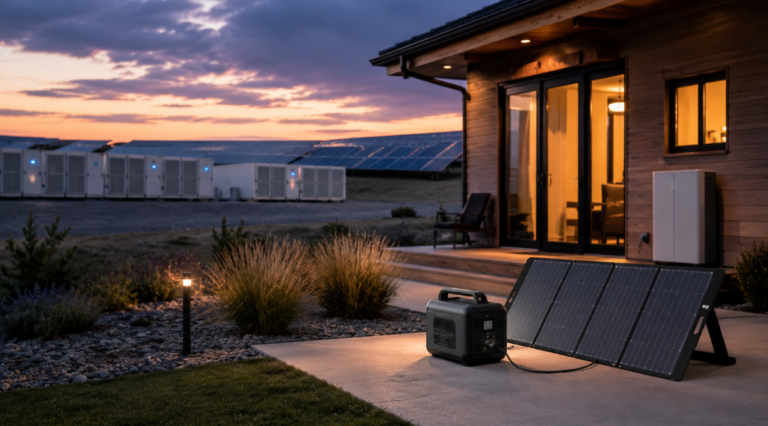
A portable solar panel connected to a portable power station is generally an off-grid charging arrangement. The panel charges a battery, and the stored electricity is later delivered through the power station’s AC or DC outputs.
Plug-in solar works differently. It feeds electricity directly into the home’s existing electrical system and therefore has to comply with local grid and electrical safety rules.
Portable power stations, balcony solar, and residential storage may eventually converge into more integrated products. For now, they remain different categories with different technical and regulatory requirements.
Once familiar retailers begin promoting plug-in solar, marketing is likely to focus on three ideas:
Low cost.
800W output.
Easy self-installation.
Those claims will not be enough to judge whether a product is suitable.
Before buying, consumers should confirm:
Importing an unverified system before the final rules and compliant models are available may create more problems than it solves.
The risks are not limited to electrical performance. Insurance, liability, installation permissions, and product support may all become issues.
An 800VA system will not power an entire house. It will not replace a professionally installed rooftop array.
That is not the right test of its value.
Plug-in solar is aimed at a different group of users: people without roof ownership, people who cannot justify the cost of a full installation, and households that simply want to offset a portion of their steady daytime electricity use.
That market has always existed. Traditional residential solar has rarely been designed around it.
Consumers should wait for the final standard and clear compliance markings rather than chasing the cheapest imported kit.
Retailers should not treat these products as ordinary solar accessories. Product screening, installation guidance, after-sales support, and recall procedures need to be in place before the first systems reach the shelves.
Manufacturers should not assume that entering the UK market is simply a matter of fitting a British plug. The real opportunity belongs to the companies that can combine compliant inverter protection, complete-system design, installation responsibility, and clear consumer education in one credible product.
We will probably know soon when the first products are due to arrive.
The more important question is whether the first wave of ordinary buyers will be able to use them safely without needing to become electrical experts.